Faculty of Arts & Science (Arts) Gold Medal Winner Sydney Whiting (BA ’26) lets genuine curiosity and a passion for community engagement guide her academic endeavours. It is an approach that defines her undergraduate journey, and has solidified her status as an exemplary student leader.
During her time at the University of Lethbridge, Whiting fully immersed herself in work-integrated learning opportunities by collaborating with the Prentice Institute, City Scholars program and the Campus Collective Centre.
This is only the beginning of what promises to be an extraordinary academic journey. Whiting was recently awarded the prestigious 2026 Rhodes Scholarship, becoming just the fourth student in ULethbridge history to receive the honour.
Altogether, Whiting's commitment to academic and community engagement demonstrates an exceptional dedication to excellence which makes her a truly deserving recipient of the Faculty of Arts & Science (Arts) Gold Medal.
Meet Sydney.
Medal won: Faculty of Arts & Science (Arts) Gold Medal
Program: Bachelor of Arts | Major: Political Science
Describe your ULethbridge experience in three words.
Meaningful. Community-based. Impactful.
What drew you to your program or field of study?
I was interested in how government and policy shape our lives, and how, through the political system, we can make people’s lives better. Combined with an interest in the politics and discourse around climate change, I found my courses through a major in political science and a minor in environmental studies to be interesting and insightful.
What is your most memorable ULethbridge experience?
In 2023, I helped organize the inaugural Student Advocacy Conference with friends at the Campus Collective Centre and the Lethbridge Public Interest Research Group (LPIRG). What started as an idea among our small staff team grew into a (now multi-year!) event to help students connect with community-based advocacy in different ways — through art, campaigning, relationship building and political organizing. It was memorable to see our efforts finally come together for the event.
Did you have an experiential learning opportunity, such as a practicum, research, co-op, applied study, residency, or other project that deepened your work?
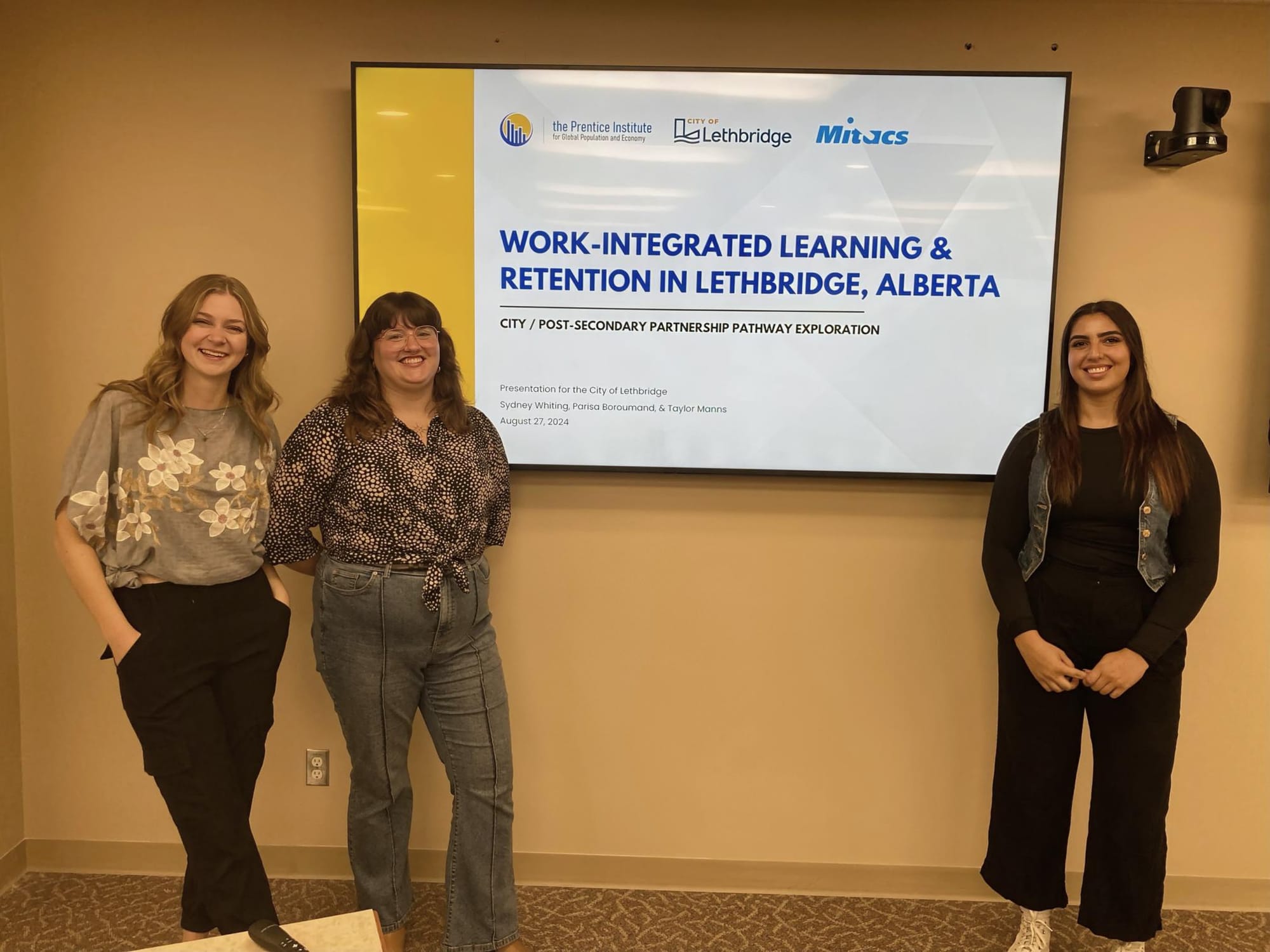
Yes! I am very grateful for the opportunities I received as a social science research student at the Prentice Institute for Global Population and Economy. I participated in an applied study course on land use and housing policy with the City of Lethbridge, undertook an eight-month Mitacs internship on student retention and work-integrated learning, and worked in several research roles — ranging in topics from rural immigration, the prevention of family and sexual violence and media populism — that deepened my understanding of public policy, political science and the research process itself.
Were there any courses, professors, or experiences that changed your perspective?
Absolutely. My boss at the Institute and thesis supervisor, Dr. Lars Hallstrom, helped inform my thinking on many different topics. He introduced me to the Deep Ecology, political economy and public policy literature, which later served as the foundation for my graduate school application. Further, Dr. Bronwyn Bragg’s Geographies of Crisis and Resistance, Dr. Stephanie Kerr’s Terrorism and Extremism in Europe, Russia, and Eurasia and Lisa Lambert’s Contesting the Public and Private Divide all stand out as courses which made me think about politics, crisis and conflict differently and have stuck with me.
Did you receive any scholarships, awards or bursaries during your studies? How did having financial support impact your education?
I was fortunate to receive several scholarships throughout my undergraduate program. In my remarks at the Donor Appreciation event this spring, I shared how grateful I was for this funding, and how it afforded a special gift: more time. More time to invest in myself through more focused studies, to invest in research and to invest in my community.
What does this academic recognition mean to you?
It is an honour to receive the Faculty of Arts & Science (Arts) Gold Medal Award. Not only is it meaningful for own work, but it reflects the incredible people and groups I was so fortunate to collaborate with, and learn from, at ULethbridge: the Campus Collective Centre, the Prentice Institute, the City Scholars program and more.
What is the most important lesson you learned during your time at ULethbridge?
To lean into my curiosity. Through support from the Prentice Institute and Dr. Hallstrom, I was able to attend conferences in Canada and abroad, contribute to academic papers and later write my own thesis. All of these experiences required me to be curious about what it meant to be a researcher, to be curious about new ideas and debates and learn new methodologies and strategies to succeed. Curiosity was always rewarded with more questions.
What are your plans for the future?
I am excited to start graduate school to build on all that I have learned at ULethbridge. I will be starting an MSc in Comparative Social Policy at the University of Oxford as a 2026 Rhodes Scholar, where I hope to focus my thesis on strategies for designing more just and socially responsible welfare policies in OECD countries in the context of the climate crisis.
What advice would you give to those who are about to begin their journey at ULethbridge? What would you tell your first-year self?
There are so many ways to get involved during school! I enjoyed my classes, but it was “other stuff” — student organizing, research, thesis writing, conferences, clubs — that really rounded out my undergraduate experience.
And to myself – I would probably give the same advice (I wish I would have joined a rec sports team sooner - so fun!).
Update your contact information with Alumni Relations.
Find us on Facebook, Instagram or LinkedIn
Read more about your fellow alumni.