Mark Lea's (BSc ’23, MSc ’25) experience at the University of Lethbridge stands as a testament to what can be achieved through hard work, perseverance and genuine curiosity.
During his graduate studies, Lea conducted computational biochemistry research examining how chemical modifications to messenger RNA influence protein synthesis, contributing to a growing field with implications for human health and disease. Alongside this work, he applied the skills obtained in his research interest to provide tangible and impactful contributions to his internship focused on community work with the Ronald McDonald House Charities (RMHC) Alberta.
His profound ability to frame every setback as a learning opportunity is an extraordinary mindset that earns him the well-deserved School of Graduate Studies Master of Science Medal of Merit.
Meet Mark.
Medal won: School of Graduate Studies Medal of Merit - Master of Science
Program: Master of Science | Major: Chemistry
Why did you choose ULethbridge for your graduate studies?
By the end of my undergraduate studies, I had been involved in research for five years and knew it was one of my passions. In Dr. Stacey Wetmore’s computational chemistry lab, I had just been getting momentum on my own research project culminating in an honours thesis and still had a number of burning questions that I wanted to answer. It was a no brainer for me to continue with an MSc so that I could tackle a more long-term and ambitious project.
What did your research and/or thesis work encompass?
My work focused on a niche but crucial area of biochemistry that gained significant attention during the COVID-19 pandemic: messenger RNA (mRNA) modifications. My thesis uses computer simulations to model ribosomes encountering different mRNA modifications and examine how those modifications influence protein synthesis. Using these simulations, I was able to explain why certain modifications have dramatically different effects on protein synthesis efficiency depending on where they are located within the mRNA sequence.
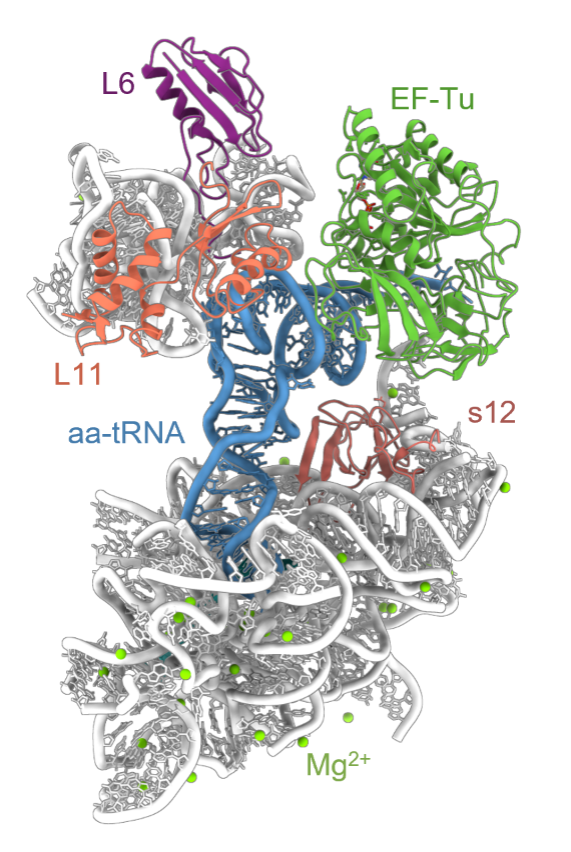
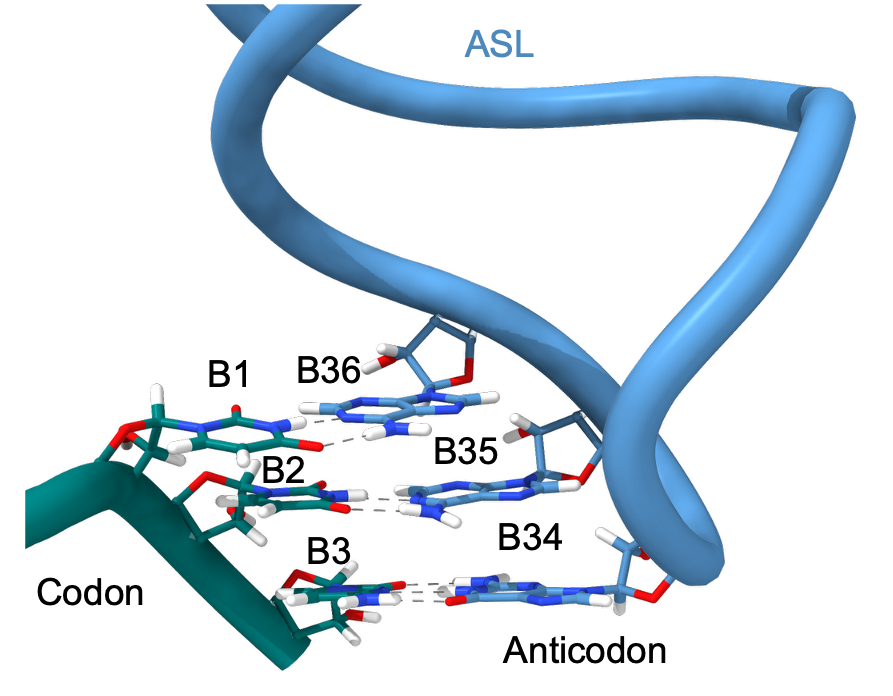
Left: computational model of the ribosome; right: transfer RNA reading genetic information by pairing with a messenger RNA.
Describe your ULethbridge experience in three words.
Innovative. Collaborative. Supportive.
What drew you to your program or field of study?
Since I was young, I have been fascinated by computers and their ability to represent complicated systems. My interest first sparked with games such as Minecraft, where I could experiment with a virtual world to my heart’s content and observe the consequences in real time. Later in high school, I attended the Chinook Symposium and encountered the concept of computational chemistry with one of Dr. Stacey Wetmore’s students’ projects. I was amazed to learn that we could understand real-world phenomena at the atomic level entirely with computers, and I approached Dr. Wetmore in my first year and got started on a project that summer.
What is your most memorable ULethbridge experience?
Outside of my research I have also had the pleasure to continue pursuing one of my passions, piano. During my undergraduate studies I was a part of Dr. Brad Parker’s studio program and I was able to continue lessons through the conservatory during my masters. My most memorable experience during my masters was competing in the Young Artist Competition. I auditioned without expecting much, but was shocked when I was informed that I was chosen as a finalist. The ensuing months of preparing a concerto with Dr. Parker were challenging to balance alongside my full-time research, but I will always be grateful for the opportunity and the many lessons I learned from this experience.
This experience and others I had in music alongside my science studies would not have been possible if it weren’t for the value ULethbridge places on liberal education and the unique environment we have that fosters community between faculty and students on campus.
Did you have an experiential learning opportunity, such as a practicum, research, co-op, applied study, residency, or other project that deepened your work?
During my second year of my MSc, I had the unique opportunity to participate in an internship through the RNA Innovation program with the RMHC Alberta.
This was a completely different working environment than I was used to in an academic research lab, but I saw how the skills I had gained from research were extremely beneficial and applicable to the goals of the organization.
Through my role, I helped pilot, build and improve software tools that provided tangible benefits to staff, families and volunteers at all four RMHC locations in Alberta. In contrast to academic research where we often do not see tangible effects for years, this experience allowed me to see firsthand how my contributions supported the organization’s day-to-day operations while teaching me to take initiative and adapt to challenges as they arose.
Were there any courses, professors, or experiences that changed your perspective?
My favourite and most influential course I took was an introduction to psychology. I catch myself still recalling tidbits of information I learned in the incredibly diverse survey of psychological research and lectures covered in this course. I was so impressed by the scientific rigour and granular attention to integrity in study design displayed.
Did you receive any scholarships, awards or bursaries during your studies? How did having financial support impact your education?
I enrolled in university knowing that my education would have to be mostly funded by scholarships, so I applied to any award or scholarship that I was eligible for. During my undergraduate studies, I received three NSERC USRAs and a collection of other awards such as the Louise McKinney Post-Secondary Scholarship, RBC and Cor Van Raay Agility Awards, the RNA Innovation Undergraduate scholarship, and the Mr. Merv Leitch Memorial Scholarship in Chemistry. I am so grateful for these awards and how they made it possible for me to focus on my grades and extracurricular activities during my busy semesters and allowing me to conduct paid research over the summers. During my MSc, I was fortunate to receive the NSERC CGS-M, Alberta Innovates Graduate Student Scholarship, and RNA Innovation Trainee Award.
What does this academic recognition mean to you?
I have been excited about this project since I first began working on it and felt a tremendous sense of accomplishment after completing my thesis and successfully defending it.
Receiving this medal means that the work I poured my heart into over the past two years resonated with others and was recognized for its impact. I am incredibly grateful and honoured to receive this recognition.
What is the most important lesson you learned during your time at ULethbridge?
The most important lesson I learned at ULethbridge was that mistakes and setbacks are often the most valuable sources of insight. While success is the goal, failure is an inevitable part of growth. Learning to examine mistakes honestly and use them to guide improvement has shaped my approach to learning through postsecondary education and life in general.
What are your plans for the future?
I have become increasingly drawn to the field of medicine throughout my academic career. Much of my research and involvement in extracurriculars like iGEM has focused on uncovering fundamental insights into human disease mechanisms or developing hypothetical synbio-based platforms for diagnosing or treating disease. While I have found this work deeply rewarding, I have always wanted a more direct role in improving the health of my community. Medicine appeals to me because it combines these scientific foundations that have shaped my education with the opportunity to apply that knowledge directly to patient care. I am excited to continue pursuing that goal this fall as I begin medical school at the University of Alberta.
What advice would you give to those who are about to begin their journey at ULethbridge? What would you tell your first-year self?
One of the most important things to understand is that graduate school is very different from undergraduate studies, and the transition can take time, especially if you are unaccustomed to a research environment. As an undergraduate, you are largely learning from an established body of knowledge. While balancing courses, exams, labs and assignments is challenging, there is some reassurance in knowing that studying hard and getting support from mentors generally lead to success.
Graduate research involves much greater uncertainty. Your supervisor, committee, and colleagues can provide guidance, but the questions you are investigating often do not have known answers. It is normal to feel unsure of whether you are approaching a problem correctly. My advice is to embrace this questioning rather than view it as a sign you are doing something wrong. Try to present your work in many contexts, such as lab group meetings, interdepartmental meetings, seminars and research conferences. Sometimes you will discover that your original approach was flawed, and although that can be frustrating, it is a normal and valuable part of the scientific process. The satisfaction of completing a project and contributing new knowledge makes the whole process worthwhile!
Update your contact information with Alumni Relations.
Find us on Facebook, Instagram or LinkedIn
Read more about your fellow alumni.