Three That Matter asks a simple question: Which three books have mattered most to you?
Following its initial launch in January 2026, this bookstore initiative has returned as an annual celebration of the books that have shaped members of our campus community.
Each week, a different member of the University community will share three books that have stayed with them, books they return to, wrestle with, or continue to think about long after the final page. The featured titles will be available through the University of Lethbridge Bookstore at a 20 per cent discount.
Together, these selections offer a glimpse into the ideas and stories that have shaped the people who teach, learn, work, and study here.
Three That Matter is an invitation to discover the people behind the reading lists, encounter something new, and maybe find a book that matters to you, too.
Erin Phillips' Three That Matter
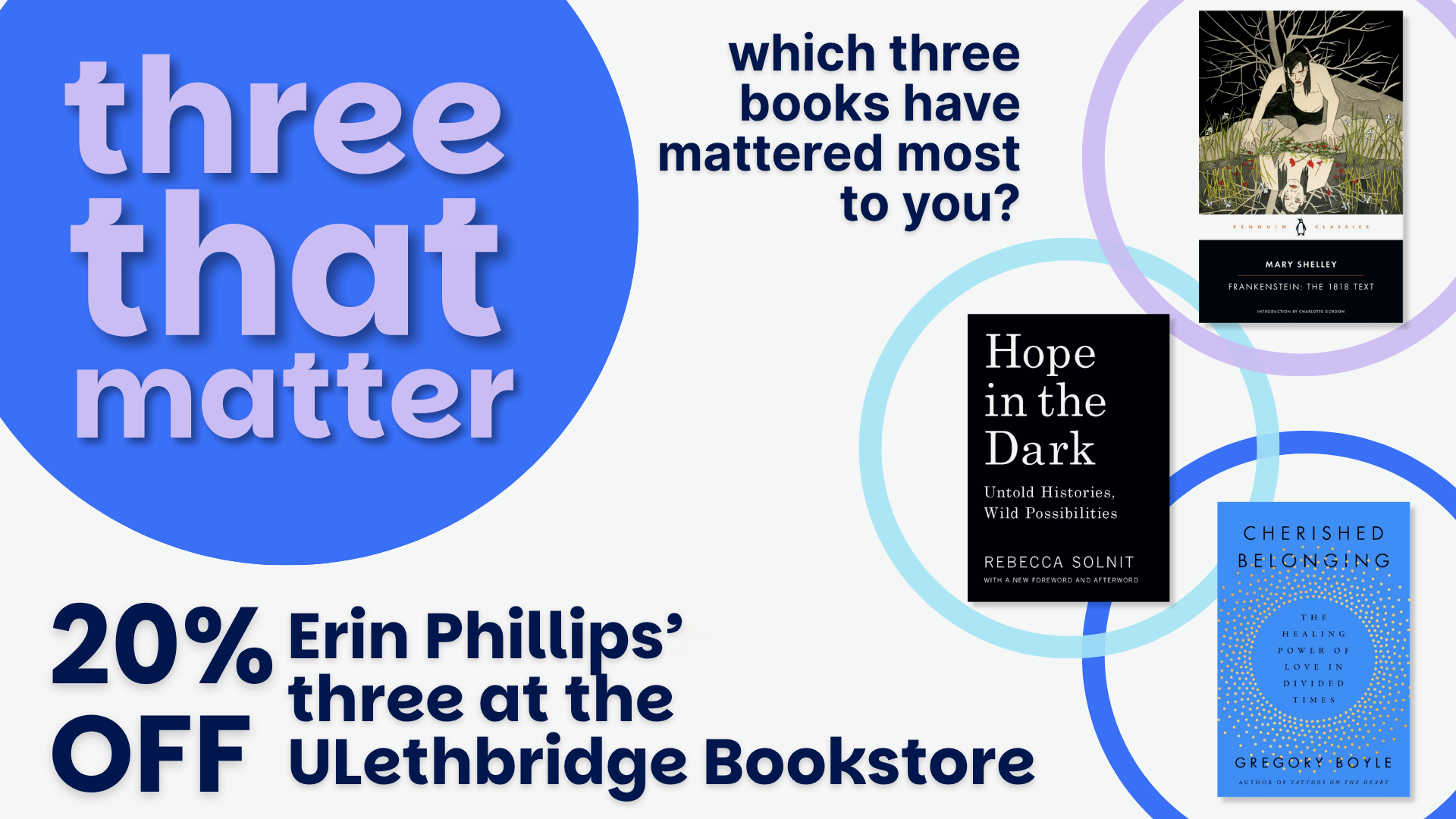
Book one: Frankenstein; or, The Modern Prometheus by Mary Shelley
Why it matters
When I was 9 or 10 my dad took me to a double bill of Boris Karloff’s Frankenstein and Bela Lugosi’s Dracula, both films made in 1931. It was the Frankenstein story that most captivated me. It was only later that I realized it was based on a novel written in 1818 and that it was just one of many interpretations of the novel. The story of Frankenstein sparked great debate immediately and for over 200 years it has been invoked in debates over science, ethics, politics, and human rights. I’m a part of a great company of people who continue to wrestle with the ideas of Mary Shelley.
Book two: Hope in the Dark by Rebecca Solnit
Why it matters
I have this book in paper, electronic, and audio versions. As long as I have my phone with me I have this book with me. It has taken up residence in my head and has sustained me through some of the most discouraging political days of the past decade. Solnit argues that hope is not optimism, the belief that things will automatically get better, nor just a repudiation of pessimism, the belief that ultimately things will never get better. Instead she argues that hope is the conviction that the future is not determined and therefore we can, or rather, must act in the hope that our actions will make a difference in ways we can not know or perhaps even imagine. That hope is fed by our memory of ways in which acts, individual and collective, have made things better, often in unexpected ways.
Book three: The Healing Power of Love in Divided Times by Gregory Boyle
Why it matters
Almost 40 years ago Fr. Greg Boyle, an American Jesuit, began working in Los Angeles to create opportunities for employment and training for young people, who had become involved in gangs and often been incarcerated. Out of that work grew Homeboy Industries which is now a massive organization considered one of the most successful gang interventions in existence. I discovered Boyle’s earlier books at a time when I was reading a lot about the interconnection between trauma and addictions and the challenges of intergenerational trauma and I devoured them. This book explores his conviction that 1) we are all unshakably good (no exceptions) and 2) we belong to each other (no exceptions). Ultimately, he is convinced that we are all in need of healing, that that healing occurs in community and that we should be thinking at a personal level and at a social and political level about what healing is necessary and how it might be achieved.
Closing thoughts
Trying to choose only three books for this was a real challenge but once I had settled on these three, I began to see how interconnected they were in my own thinking. In many ways they all contribute to my own efforts to wrestle with what can be done to make our community more whole and healthy.