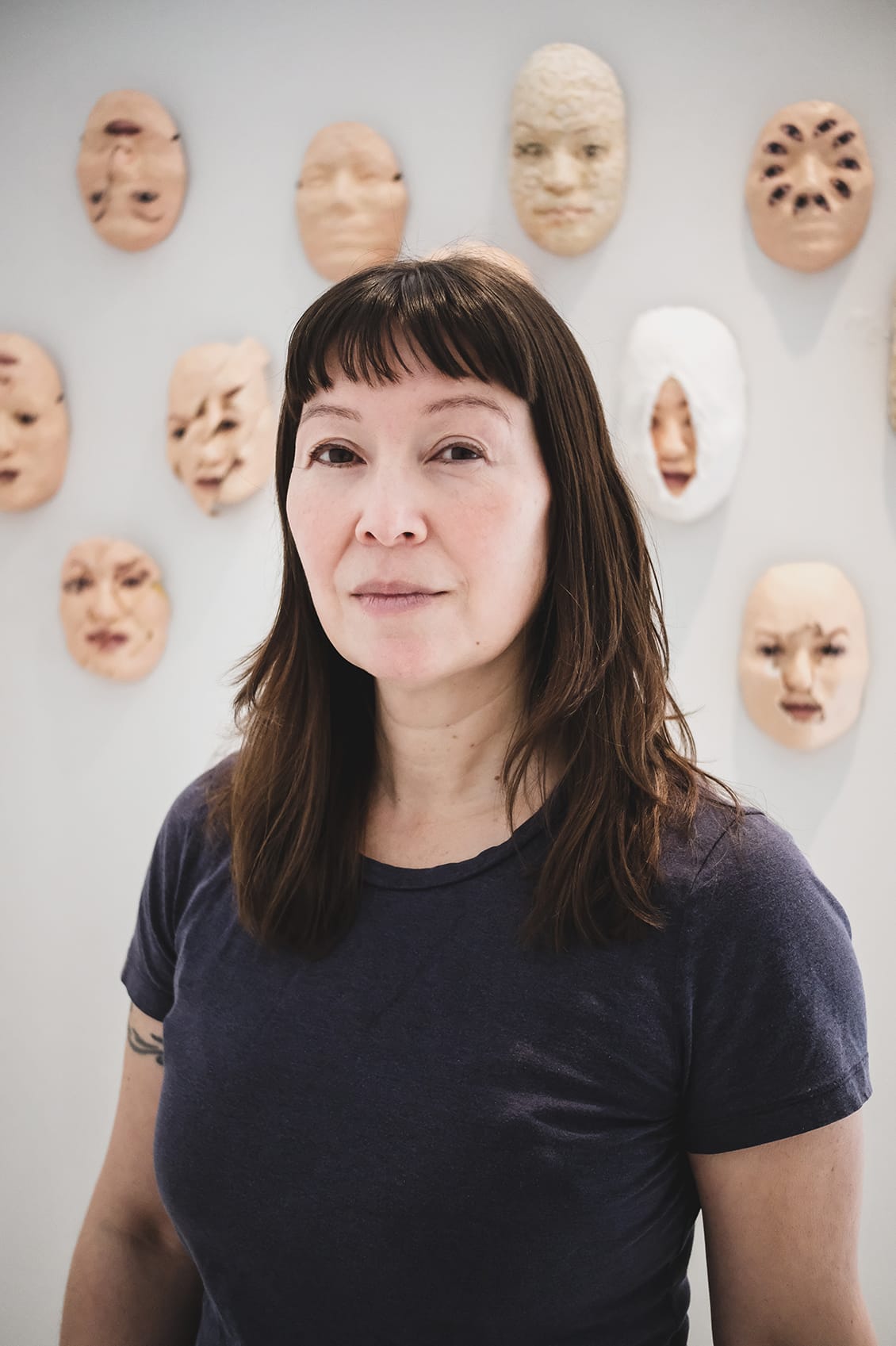
For alumna Miya Turnbull (BFA - Art '00), a curiosity with masks that began during her studies at the University of Lethbridge has grown into a multidisciplinary artistic practice. Miya's work spans sculpture, photography, animation, video and performance. Rooted in identity and transformation, Miya's work has taken her across Canada and the world through exhibitions and collaboration.
As she prepares to return to ULethbridge for a new performance work, Miya reflects on the people, places and ideas that have shaped her creative journey and her full circle moment.
Meet Miya. Creative. Hard-working. Grateful.
What inspires your creative practice?
It started with a childhood fascination with masks and puppets, and the way an object could transform whoever was behind it. I made my first masks at the University of Lethbridge about 30 years ago and never stopped. I’m inspired by identity and how layered it is. Every mask is cast from my own face, then changed in ways I could never change myself in real life, and wearing them lets me step outside my own image and look back at it.
Growing up between Japanese and British heritage, I’ve always been drawn to the in-between, and the masks let me live there on purpose.
Why is it important to support arts communities and foster talent for future generations?
Art is one of the ways we make sense of who we are, individually and together. It asks questions, holds space for complicated feelings, and helps us understand lives different from our own. But no artist does it alone.
Over the years I’ve been shaped by teachers, fellow artists, dancers I’ve collaborated with, and the galleries and artist-run centres that took a chance on my work. Talent needs time, mentorship and community to grow. Supporting young artists keeps that cycle going, so the next generation can find their voice and eventually pass it on.
Why did you choose to pursue fine arts at the University of Lethbridge?
I ended up choosing ULethbridge over other schools I considered in Alberta and BC, and in the end it came down to family and connection. My mom grew up in Lethbridge, and my grandparents lived there, so we visited regularly my whole childhood.
My path through the program wasn’t a straight line, though. I started in a combined biology and art degree, then tried psychology and art, and finally switched to a BFA when I realized art was where my real passion was. Looking back, biology and psychology never really left me. My work is still all about the face, the body and the self.
What was your most memorable ULethbridge experience?
The people, for sure. Some of my closest friends today are people I met at ULethbridge and my best friends are from that time in my life. The program itself was also really strong, with memorable instructors and professors who made a real impact on me, such as Janet Cardiff. And I loved that I got to take so many different classes, like anthropology and religious studies, which helped round out my practice in ways I still feel today.
What has your post-graduate journey looked like? How has your degree continued your professional and personal growth?
Like my time at ULethbridge, my path since graduating hasn’t been a straight line. I came out of school with student loans and no real idea how the art world worked: grants, proposals, how to get your work seen. It took time to figure that out. Nova Scotia is where things finally clicked; my self-portrait masks found support there, and the work started to grow. Then I took about ten years away after my daughter was born, and when I came back, I came back full force.
Since then I’ve been fortunate to have so many opportunities to exhibit my work here in Canada and internationally, and in 2025 I was longlisted for the Sobey Art Award, which was a meaningful milestone for me. Through all of it, the foundation I built at ULethbridge, the curiosity, the mask-making, the wide range of classes, has stayed with me.
What is a recent career highlight?
This fall feels like a real full-circle moment. I am touring with dance artist Shion Skye Carter to present our co-creation “Omote (面)” throughout Alberta, performing with over 100 of my masks. Coming back to Lethbridge is especially meaningful, and we made a point of making it happen, even without a presenter like we have in Calgary and Edmonton.
As a student, I used to attend ULethbridge’s Art NOW artist talk series 30 years ago, and now I’m returning to present my own work there.
We are also offering an Origami and Movement Workshop at Nikka Yuko Japanese Garden, where I used to work. “Omote (面)” is an important piece in the evolution of my practice, and it carries themes of family, ancestors and the histories that shaped us, so bringing it to a city so tied to my own family history means a lot.
What piece of advice would you give to students?
Success as a full-time artist is possible, but it takes a ton of work, a lot of support, and never giving up. I’ve always thought of it as fishing. You put exhibition and grant proposals out there over and over again, and yes, there’s a lot of rejection, but when you get a bite, it’s because someone really loves your work and sees its value. And even a rejection means someone has seen your work, and every proposal helps you strengthen and articulate your ideas. Stick with your ideas over time, too.
My masks started at ULethbridge 30 years ago, and they’ve grown into a massive body of work encompassing sculpture, photography, animation, video, projection and now performance.
• Awards, scholarships & student supports
• Productions, exhibitions, concerts & more
• Applied studies, internships & a range of work experience
• Enhanced education opportunities locally, nationally and abroad
Get involved!