Complex, deeply human relationships are at the heart of the winning scripts for the 2026 Play Right Prizes at the University of Lethbridge. This year’s winners are Steele Prefontaine, Nikko Hunt and Naima Rain.
From two estranged brothers confronting the weight of their shared past, to a sharp critique of the beauty industry, to a haunting exploration of family, addiction and intergenerational trauma, this year’s student playwrights are tackling challenging themes with imagination and emotional depth.
Supported by Chancellor Terry Whitehead (BA ’94), the annual Play Right Prize competition celebrates excellence in student playwriting while helping emerging writers bring their work from page to stage. Winners receive tuition credits and dramaturgical support to further develop their scripts, with the first-place play receiving a staged reading at the annual Play Right Prize and Spirit Prize Gala.
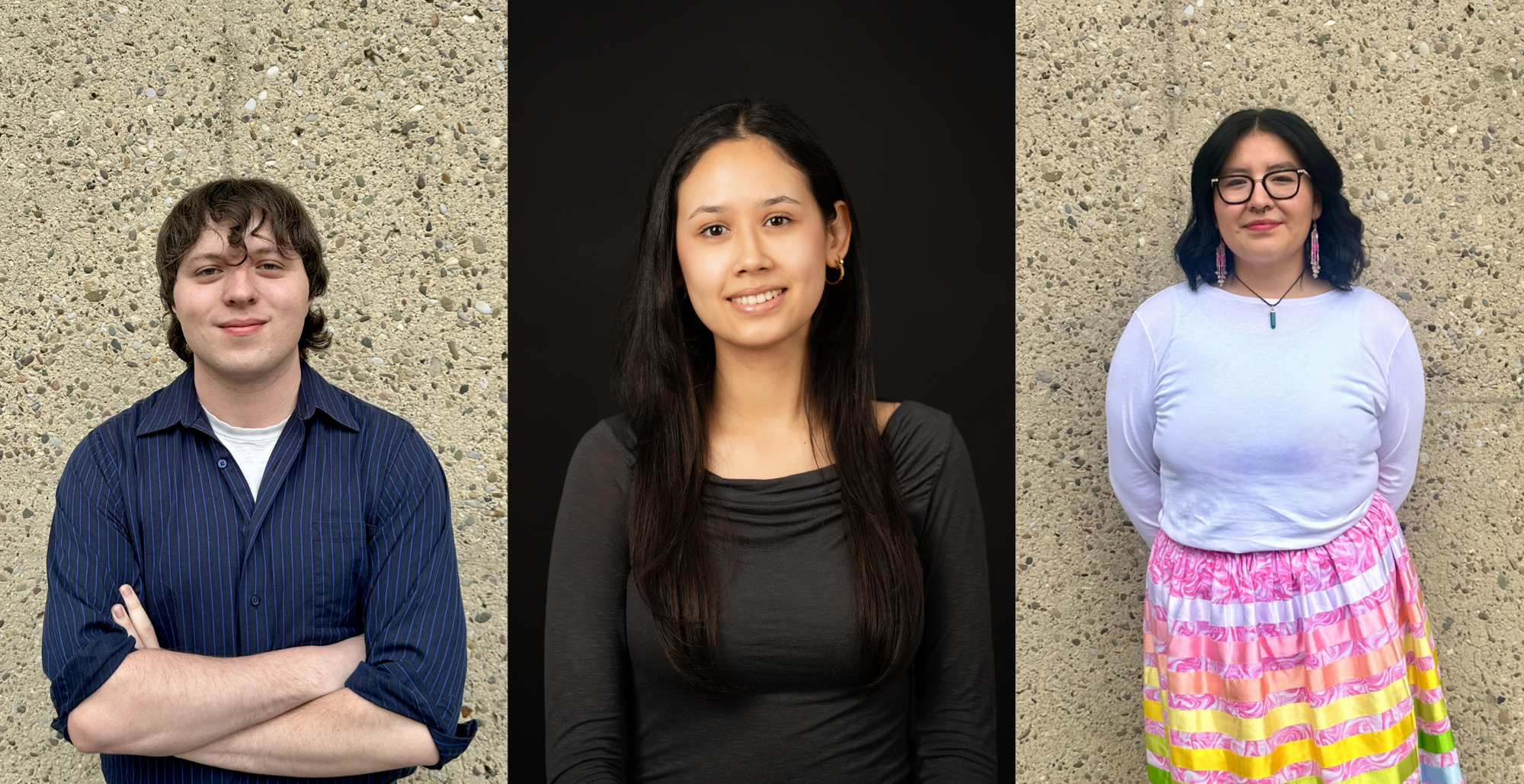
Left to right: Steele Prefontaine, Nikko Hunt, Naima Rain.
Homebodies by Steele Prefontaine
This year’s first-place winner is fourth-year Drama (Tech/Design) student Steele Prefontaine. His script, Homebodies, follows the final days of two brothers, Ira and Harpo, at odds with each other.
Ira, a hoarder, cares for Harpo, who finally decides to speak up against his caretaker. The two find themselves at a standstill as they confront themselves, their past and the complicated bond that ties them together.
Steele drew inspiration from the real-life story of Homer and Langley Collyer, two brothers who became tabloid fixtures in the 1930s for their reclusive lives in New York City.
The Play Right Prize jury noted the pull of opposing themes of care and resentment, turning the myth of sibling rivalry on its head to create an absurd and confronting story.
"Homebodies plays out like a post-war, post-retirement version of two brothers stuck indoors on a rainy Saturday, fighting over who gets the Nintendo controller," the jury noted.
“When learning about their story, I found an inherent dramatic tension as I imagined what their final days must have been like. They became the basis of my characters, Ira and Harpo,” Steele says.
He adds that he changed the play's setting to capture the inspiration he found in his hometown.
“I found creative freedom in taking their story and transplanting it into rural Saskatchewan. Placing the story in Saskatchewan was an integral change in finding the tone of the play. I was able to draw on imagery, language and stories of the people and the land," he says.
"I pictured my characters living in one of the many houses that you can find abandoned along the highway. I’m always curious about what kind of lives inhabited these prairie time capsules, and why they were left behind. It found its footing after that change.”
The idea for Steele's play had been on his mind since 2022, but it wasn't until he took Playwriting I with Greg MacArthur in 2024 that he began writing it.
"Greg cultivated a classroom that felt like a writer's circle, where we were able to experiment and work with our pieces without fear or judgment. I felt respected as a beginner playwright, which allowed me the confidence to write without worry."
Steele was able to create a production for his script through Lyric Theatre in Swift Current, marking a full-circle moment as he says he grew up watching plays put on by the organization.
The production was small but taught me a lot about the script after working with a cast, crew and audience," he says. "A couple months after the production I entered my deepest research phase — watching and reading testimonies of pioneers and their kin who lived in the province at the time, and colonizers' relationship with the land and place on the plains."
As the first-place winner, Steele will have a staged reading of Homebodies during the Play Right Prize Gala, and he says he already has ideas on where he wants the script to go next.
"Getting dramaturgical support from Alberta Playwrights Network and feedback from those who attend the staged reading will paint a clear picture on my point of attack for draft seven," he says.
"I’d love to one day massage it out to a point where I’m ready to get it published. I’m always willing to connect with people and companies interested in working with me as a playwright."
Hot Commodity by Nikko Hunt
The first runner-up is Drama (Performance) student Nikko Hunt. For her play, Hot Commodity, Hunt explores a mentor/mentee relationship between two young women in the cosmetics industry.
Erin has just moved to a big city to be with her boyfriend, who has callously dumped her as the play begins. Alone, jobless, and adrift, Erin has a chance encounter with Juliette in a bar and they realize they are from the same small town in Alberta.
Juliette is an ambitious marketing executive with a cosmetics company and takes Erin under her wing as an assistant, with surprising consequences as the two quickly become competitors in a high-stakes battle to develop a startling new product.
Described by the prize jury as a timely, fast-paced and chilling critique of the beauty industry, Nikko says the idea for her play came from realizing how much her life had been consumed by makeup and skincare products.
“I have spent more than I would like to admit on products that sometimes just sit on my dresser. The main culprit that kept influencing me to buy more was social media," she says.
"Every time I would open my phone there would be a new lip gloss out, or worse, a new perfume that was a ‘must have’. After a while you start to wonder if it is actually a great product or just great marketing."
Nikko began workshopping her play in her Playwriting II class with Greg MacArthur, receiving helpful feedback from her classmates to help guide further drafts.
"Having opportunities like the Play Right prize, gives emerging artists incentive and something to reach for besides good grades," she says. "For me, it gave me agency and a space to really push myself and find motivation within myself."
Goodbye See You Later by Naima Rain
Third-year Drama student Naima Rain is the second runner up for the Play Right Prize with her play, Goodbye See You Later. The play explores the relationship between a father and daughter, taking place in limbo as the duo unpacks intergenerational traumas, addiction and the effects of residential schools.
The prize jury praised Naima’s submission as a mature and devastating testament of imagination, noting the script acts as both a lullaby and an elegy.
"An aching account of drifting families and courageous survivors, the play beckons us to bear witness to a tender act of grieving. Somewhere in a realm between the living and the dead, Sootaina struggles to find the words to reach his teenaged daughter, who, in turn, stretches out—across time and space—to meet them," the jury notes.
“By the end of the play, you are left wondering if the daughter will follow in his footsteps, as so much of her is made up of him,” Naima says.
“The play itself was inspired by a conversation between my grandfather and me about tipi rings, and traditionally how, when someone passed away, their tipi ring would be closed, making it a death lodge.”
Naima adds that the play is based on their relationship with their late father. She says writing the play was a way of honouring him, coming from a place of understanding of who he was, and what he lived through.
"Losing your parent to addiction at a young age is a hard thing to navigate, especially in a world that demonizes addicts. So, it became important to me to tell a story that humanizes people who struggle with addiction, without glorifying drug use, and really showcasing the effects it can have on the people around you," she says.
Naima says this is the first play they've ever written, incorporating aspects of verbatim playwriting from their father's social media, and slowly incorporating their own poetry into the work.
"After I had the foundation of the story I wanted to tell, I started to slowly share the play with peers in the Drama department, and getting their feedback of what they wanted me to expand on, and how the relationship between the Father and his use of drugs were coming across. The last thing I looked at was the Daughter, and the Father's story from her perspective," Naima adds.
She says that she's proud that her father's story is being told and winning the prize has boosted her confidence as a playwright.
"I think for me it has proved a sense of motivation to keep creating work, and writing new pieces. I spent my first year and a half at ULethbridge abandoning creative writing, but now I see the importance of allowing your creativity to flourish," she says.
"Especially in a learning environment where you have the tools to improve your craft, and are surrounded by other creators who can help you in your process.
Steele, Nikko and Naima will be recognized at the annual Play Right Prize and Spirit Prize Gala on March 19. The winners receive $1,500, $750 and $250 respectively in tuition credits.