Three That Matter asks a simple question: Which three books have mattered most to you?
Following its initial launch in January 2026, this bookstore initiative has returned as an annual celebration of the books that have shaped members of our campus community.
Each week, a different member of the University community will share three books that have stayed with them, books they return to, wrestle with, or continue to think about long after the final page. The featured titles will be available through the University of Lethbridge Bookstore at a 20 per cent discount.
Together, these selections offer a glimpse into the ideas and stories that have shaped the people who teach, learn, work, and study here.
Three That Matter is an invitation to discover the people behind the reading lists, encounter something new, and maybe find a book that matters to you, too.
Kari Tanaka's Three That Matter
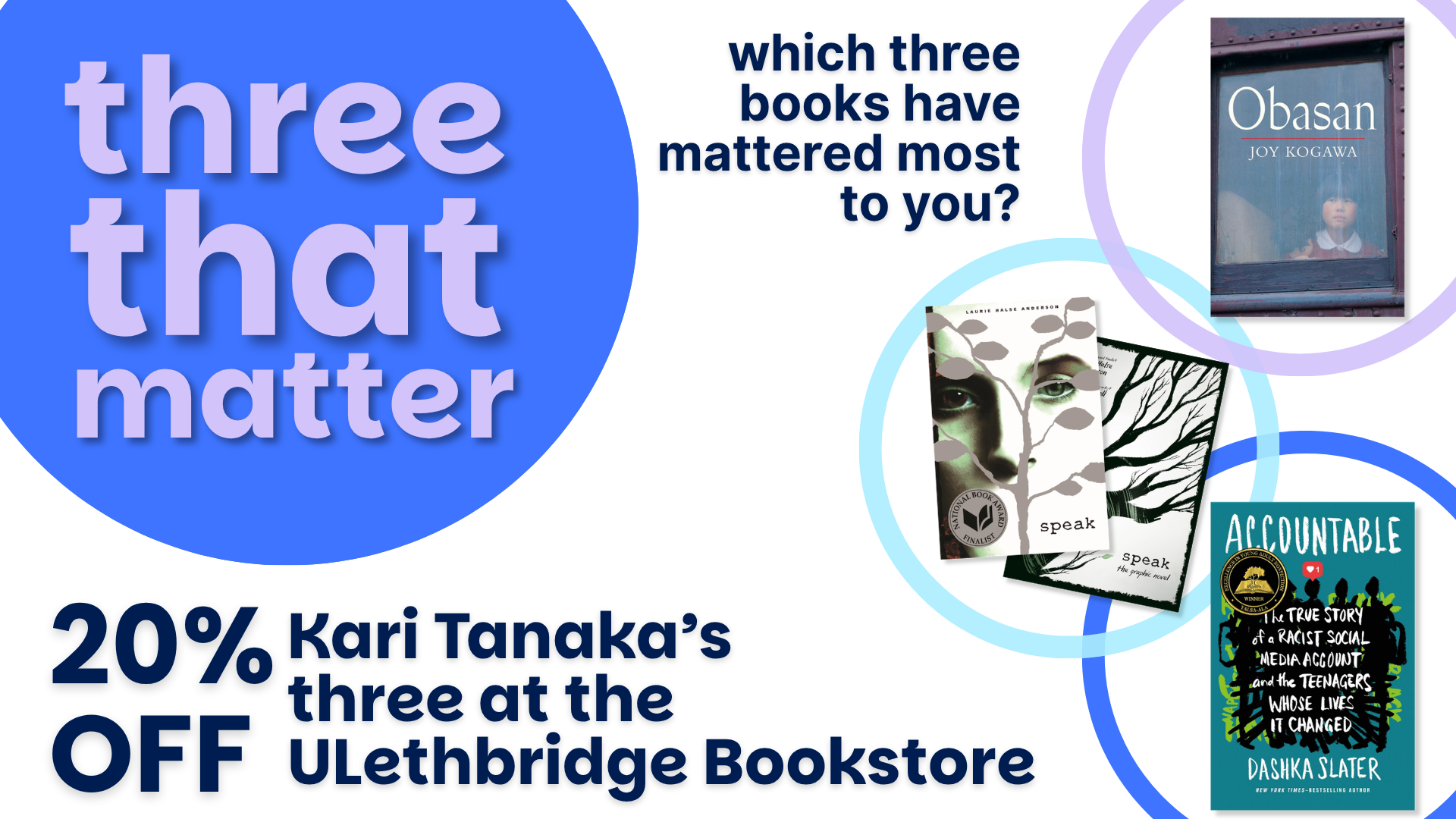
Book one: Obasan by Joy Kogawa
Why it matters
I was in elementary school when the Japanese Canadian Redress Agreement was signed on Sept. 22, 1988. I remember my parents and older brother being glued to the evening news and a flurry of phone calls between my dad and his siblings discussing the settlement and formal apology. This is the first time I recall hearing about the internment. My curiosity was piqued but it was not something my dad, grandparents, aunts and uncles, were eager to discuss. Kodomo no tame, for the sake of the children.
Fortunately, I had an older brother who was an avid reader and parents who let me read anything, regardless of my age. My brother loaned me his copy of Obasan, by Joy Kogawa, and it was through this novel that I gained entry into the scars of Canada’s past and the impact that the internment had on my family.
I have read this novel multiple times since then. It is poetic, poignant and still relevant decades later. Each time I read it I am reminded of how easily fear can be manufactured and also how, no matter how much we may want to shield children from hard truths, they can always feel what’s going on even if they don’t know what’s going on.
Since Obasan’s publication in 1981, Joy Kogawa has published a middle grade novel called Naomi’s Road and a picture book called Naomi’s Tree making Naomi’s journey accessible to a variety of audiences.
Book two: Speak by Laurie Halse Anderson and Speak: The Graphic Novel by Laurie Halse Anderson
Why it matters
Speak, by Laurie Halse Anderson, is the book that sparked my passion for young adult literature and confirmed my commitment, as a bookseller and book nerd, to get the right books into the right hands at the right time. Speak is a complete and utter gut punch, allowing readers a glimpse into Melinda’s fractured high school experience, an experience sent spiraling when she is raped at an end of summer party. The writing is disjointed, raw and most importantly, not condescending to its teen audience. I admire this author and others like her who show such respect for teen readers and who recognize that, while we cannot shield young people from the horrors that may already be happening to them or their friends, we can empower them by making them feel less alone.
Despite numerous book bans, Speak continues to hold its own as one of the most powerful young adult books ever written. It was subsequently adapted into a movie in 2004 and into a graphic novel in 2018, bringing Melinda’s story to a new and broader audience.
“Censoring books that deal with difficult, adolescent issues does not protect anybody. Quite the opposite. It leaves kids in the darkness and makes them vulnerable.” — Laurie Halse Anderson
Book three: Accountable by Dashka Slater
Why it matters
Published in 2023, Accountable hit my desk at the same time that a series of unfortunate events was unfolding at my kids’ local high school and although the circumstances were different, the parallels were uncanny! I read the book in one sitting and have since recommended it countless times. While written with a young adult audience in mind, I truly believe Accountable should be required reading for teachers, students, school administrators, parents, city council members and anyone who is a member of a community of any kind. So, pretty much all of us! Here’s why:
· Accountable is written from a variety of perspectives with each chapter written in short bursts. Each chapter had me believing that the perspective presented was correct — until I read the next chapter.
· Accountable really opened my eyes to how differently adults and teens engage with social media. These differences can lead to vast misinterpretations of what each post, comment and like actually means.
· Accountable is filled with good intentions that go horribly wrong. Fascinating!
· Accountable made me wrestle with the question of what accountability is and who gets to decide when someone has been adequately held accountable. This is the same question I wrestled with when I read Slater’s, The 57 Bus. At first glance, I wanted to throw these teens to the wolves for their choices but Dashka's writing provides timely reminders that the perpetrators are teens trapped in systems that may be stacked against them.
I am obsessed with books that challenge my own values, world views and biases. Accountable had me questioning my opinions at every turn!
Closing thoughts
Some parting thoughts from my own book loving journey as an avid reader and an enthusiastic bookseller:
· Life is too short to read a book you don’t like. Read what you want, when you want!
· Picture books are for everybody! (And so are middle grade and young adult novels!)
· Sometimes, books find you when you least expect them. It’s like the kitten distribution system! Embrace the process!