What happens when composers, performers, students and communities from different places and musical traditions come together?
For New Music Lethbridge Alberta (LAB), the answer is Unfamiliar Trails Coming Together — a week-long celebration of contemporary Canadian music taking place across southern Alberta from Sept. 21 to 27, 2026.
New Music LAB is a composers and performers collective based in southern Alberta, created to give contemporary Canadian music a stronger presence in the region. Its members include established and emerging artists working across composition, performance, Indigenous music, film, interactive media, live electronics and digital lutherie (the design and construction of new musical instruments).
About the New Music LAB
Music associate professor and composer Dr. Arlan Schultz says the New Music LAB was created in response to a lack of opportunities for contemporary Canadian music in southern Alberta, where audiences and artists have historically had limited access to contemporary music programming.
"We saw a need for a locally rooted organization that could connect composers, performers and audiences while creating opportunities for new work, repeat performances, artistic experimentation and collaboration with leading Canadian ensembles."
Ultimately, the LAB aims to build a stronger music ecosystem in the region and connect the southern Alberta community more meaningfully to the national contemporary music community.
What sets the New Music LAB apart is its focus on collaboration, shifting composition away from largely being a solo act, toward a more collaborative process.
"Bringing composers and performers together early allows ideas to be tested, challenged, reshaped and sometimes completely reimagined through the practical knowledge and creative instincts of the musicians themselves; it has also encouraged us all to think more fluidly about the relationship between acoustic instruments, technology, gesture and performance," Arlan says.
"The result is that the act of composing becomes less about delivering a finished object and more about creating the conditions in which genuinely new musical possibilities can emerge."
Those conditions include building relationships with audiences rather than simply presenting concerts. Arlan says the LAB meets people where they are, connecting contemporary music to place, community, education and lived experience. This means creating multiple points of entry through talks, workshops, sound walks, technology and collaboration.
"One assumption I hope we can challenge is that new music is inherently difficult, elitist, or only for specialist audiences; when people are invited into the creative process and given meaningful ways to engage, unfamiliar music can become both immediate and deeply relevant."
This sentiment is being put into practice during the Unfamiliar Trails concert series across southern Alberta.
Unfamiliar Trails Coming Together
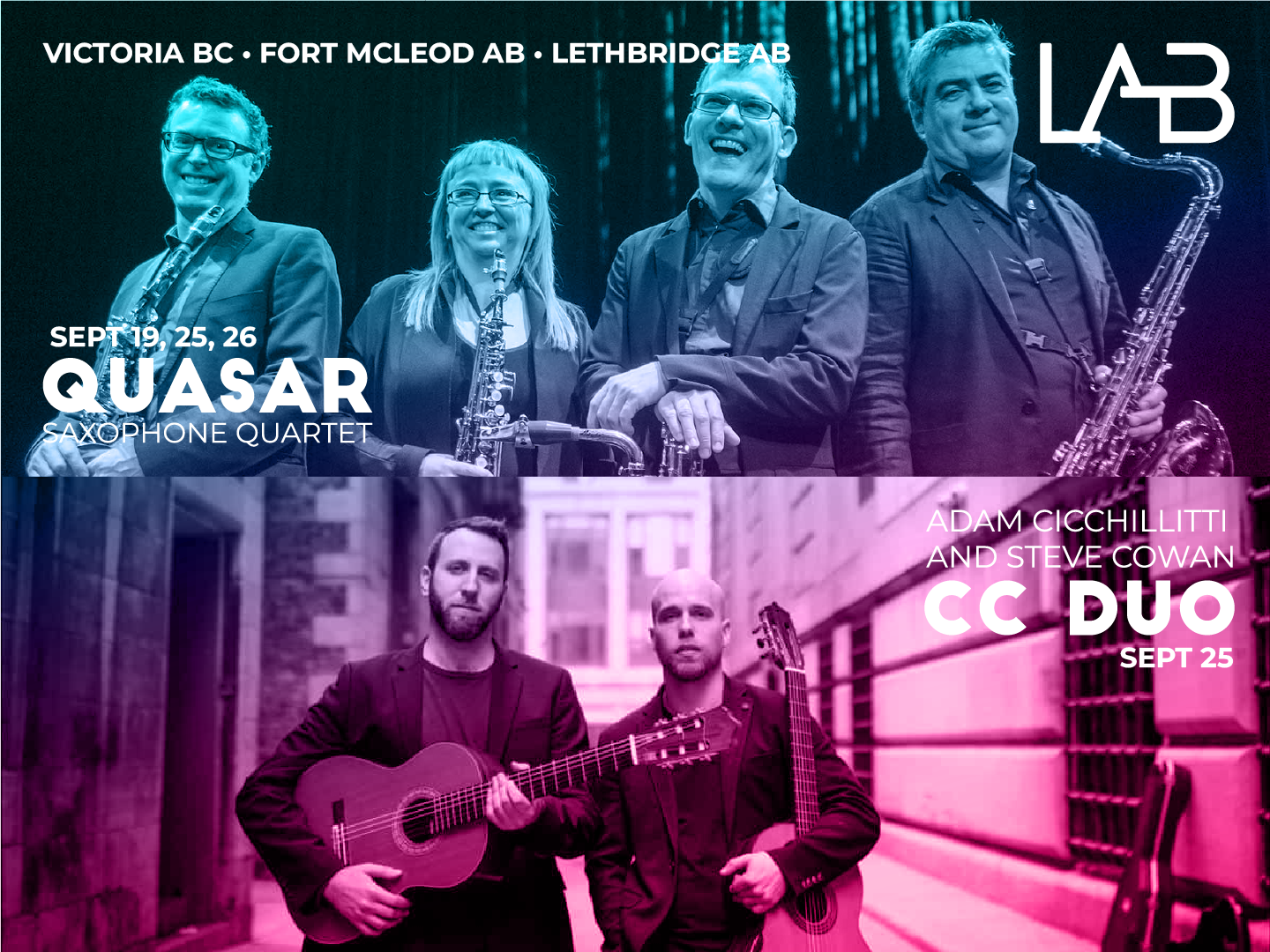
Unfamiliar Trails brings those different paths together in a series of performances, featuring world premieres and reprised works by Canadian composers, performed by artists including Montreal’s Quasar Saxophone Quartet, the Cicchillitti and Cowan Guitar Duo and Lethbridge’s Musaeus String Quartet. It also brings together artists working across acoustic and electronic music, including composer-technologist Dr. D. Andrew Stewart, who will perform on the Karlax, a digital musical instrument.
Arlan says the idea of Unfamiliar Trails grew from the image of trails converging.
"[It's] artists following different geographic, cultural and creative paths coming together to encounter unfamiliar sounds, technologies, instruments, landscapes and one another. For us, the “unfamiliar trail” is also an invitation to move beyond established ways of listening and making music, while thinking more deeply about place, the land, and the diverse communities whose paths intersect here."
He adds that the central artistic idea for the group is how unfamiliar encounters with sound technology, place and one another can become a catalyst for new forms of musical expression.
"Unfamiliar Trails explores what happens when composers and performers from different regions and practices come together across acoustic, electronic, Indigenous Classical and experimental traditions, allowing those intersections to reshape how music is created, performed and heard."
A Path for Music Discovery
But, the project isn’t limited to the concert stage. In Fort Macleod, New Music LAB is partnering with the A’sitapiiksi Powwow Club and the Prairie Winds Secondary School Drum Line to explore communication and transmission in nature through an adaptation of Drum Grid by Diné composer Raven Chacon. Other performances and events will take place at La Cité des Prairies in Lethbridge and the Centre for the Arts at ULethbridge.
For New Music LAB, these collaborations are at the heart of what it means to be a "lab".
"New music is strongest when it is developed through experimentation, exchange and discovery," Arlan says. "In practice, that means giving composers and performers time to test ideas together, workshop works-in-progress, explore new technologies and instrumental possibilities, and allow collaboration itself to shape the finished work. The result is a creative environment in which artists can take risks, learn from one another and develop new musical practices collectively."
Rather than treating new music as something distant or difficult, New Music LAB sees it as an opportunity to connect people with new ideas, new sounds and new ways of experiencing the world around them.
"Looking ahead, we hope New Music LAB becomes a lasting hub for contemporary music in southern Alberta: a place where composers, performers, technologists, students and communities can meet, experiment and build work together while remaining connected to the broader Canadian new-music network," Arlan says.
"Success would mean creating sustained opportunities for artists to develop and revisit ambitious work, while audiences across the region come to see new music not as something distant or specialized, but as a vital part of their own cultural life."