The Alberta cattle industry has earned its reputation as a producer of some of the world’s highest quality, most tender and flavourful beef. Alberta beef resonates as the gold standard — a tradition of excellence that is respected both within the country and around the world. As such, a multi-million-dollar cattle breeding industry also serves as a major economic driver in the province.
Now, new transdisciplinary research between the University of Lethbridge and the University of Calgary could play a key role in further supporting the breeding industry by making it easier to identify the most virile bulls in the herd. The research team’s work has upended long-held beliefs about the biological process that sperm undergo while travelling through the female reproductive system — findings that could open the door to a much greater understanding of reproductive biology and fertility.
Male fertility is crucial in animal breeding systems and particularly integral to the cattle breeding industry where cryopreserved semen from an elite bull is distributed worldwide to breed numerous cows through artificial insemination.
Dr. Nehal Thakor, a molecular biologist in the ULethbridge Department of Biological Sciences, and Dr. Jacob Thundathil, a reproductive physiologist and veterinarian in UCalgary’s Faculty of Veterinary Medicine, have combined the expertise of their labs to examine the problem, utilizing bovine sperm samples.
Their paper, authored with PhD student Dr. Saurabh Tiwari (University of Calgary), Systematic mRNA interactome analysis reconceptualizes translational quiescence in bovine sperm, was recently published in the esteemed Nature Portfolio journal, Communications Biology.
“Currently, veterinarians try to assess how sound a bull is as a breeder by looking at its overall health and microscopic evaluation of sperm quality,” says Thakor. “But what our findings suggest is that we should not end there, rather we should be looking deeper and understanding the molecular mechanisms in place.”
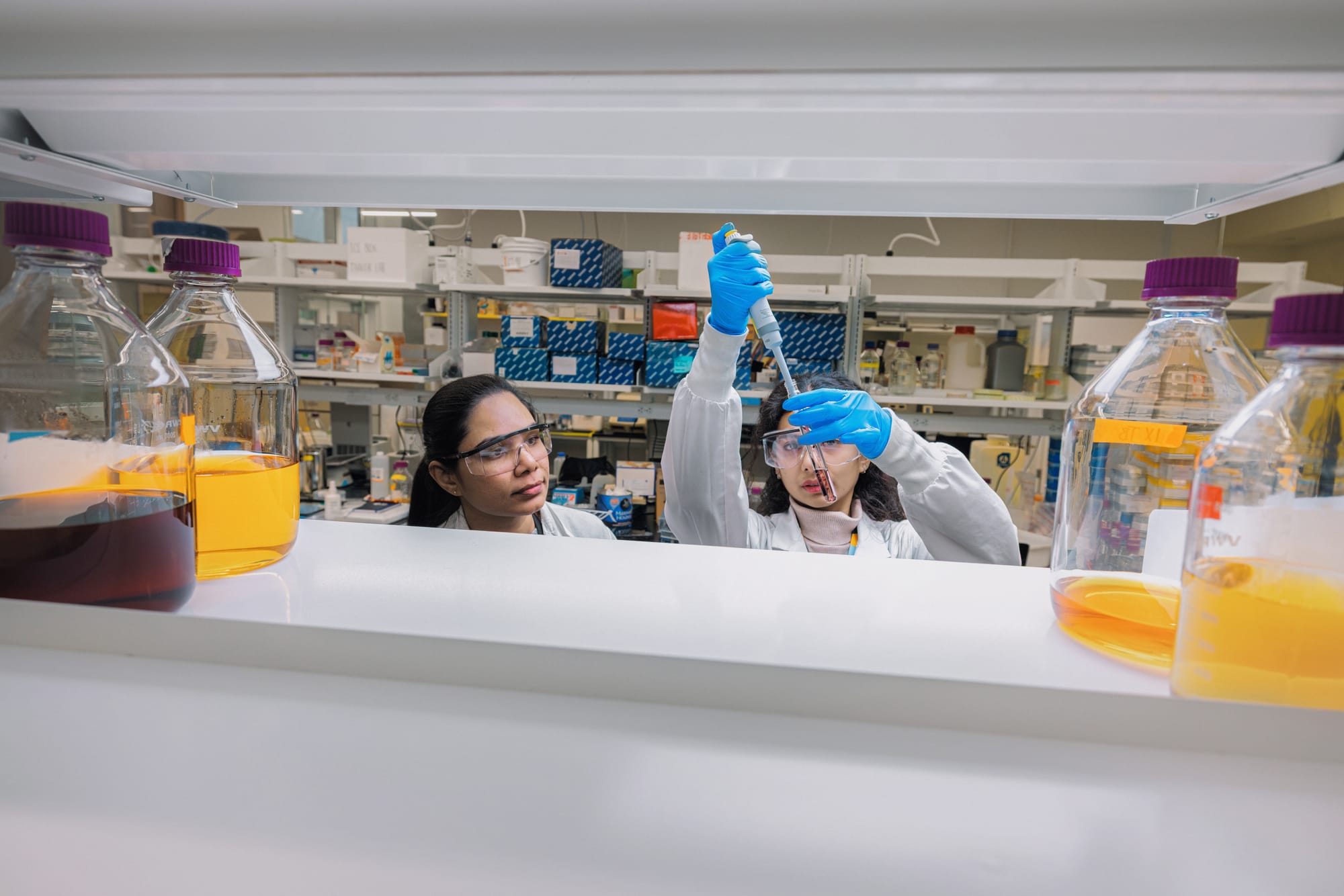
Recognizing that over the past decade there has been a surge of interest in improving male fertility across species, Thakor (ULethbridge), Thundathil (UCalgary) and Tiwari (UCalgary) began looking beyond the accepted conventions of what makes sperm fertile.
“Male factors contribute to approximately half of infertility cases in humans, with unexplained infertility affecting one out of three couples, primarily attributed to these factors,” says Thundathil. “The clinical values of conventional semen analysis, such as sperm motility, concentration, and morphology, are inadequate in diagnosing male infertility as they do not account for sub-microscopic or molecular-level differences in sperm.”
Through their work, the group discovered that as sperm undergo capacitation in the female, a biological process required to gain fertilization capabilities, mRNA translation (protein synthesis) is activated, and new proteins are made. It was previously thought that sperm were translationally quiescent (in a dormant state) during capacitation.
“What this means is that mRNA is not just being carried along by the sperm, waiting to activate when fertilization begins, rather they are activated as part of the capacitation process and may play a role in that process,” says Thakor. “That’s telling us that for an improved evidence-based diagnosis and infertility treatment, we need to better understand the molecular mechanisms governing male fertility.”
He gives the example of a bull that produces a million sperm, all of which are motile, and yet during capacitation, most of them turn out to be infertile. On the other hand, another bull could produce half as many sperm but yield many more fertile sperm because the translation process is more successful. Their study lays the groundwork for a pathway to figuring out why.
“We have some idea of the different genes that are activated,” he adds. “Using biomarker identification, we think that there might be a chance for intervention to enhance fertility.”
The new approach offers great promise that by better understanding the reproductive biology and fertilization process, greater successes will be realized in achieving fertility, thereby transforming the breeding industry.