Three That Matter asks a simple question: Which three books have mattered most to you?
Following its initial launch in January 2026, this bookstore initiative has returned as an annual celebration of the books that have shaped members of our campus community.
Each week, a different member of the University community will share three books that have stayed with them, books they return to, wrestle with, or continue to think about long after the final page. The featured titles will be available through the University of Lethbridge Bookstore at a 20 per cent discount.
Together, these selections offer a glimpse into the ideas and stories that have shaped the people who teach, learn, work, and study here.
Three That Matter is an invitation to discover the people behind the reading lists, encounter something new, and maybe find a book that matters to you, too.
Don McIntyre's Three Four That Matter
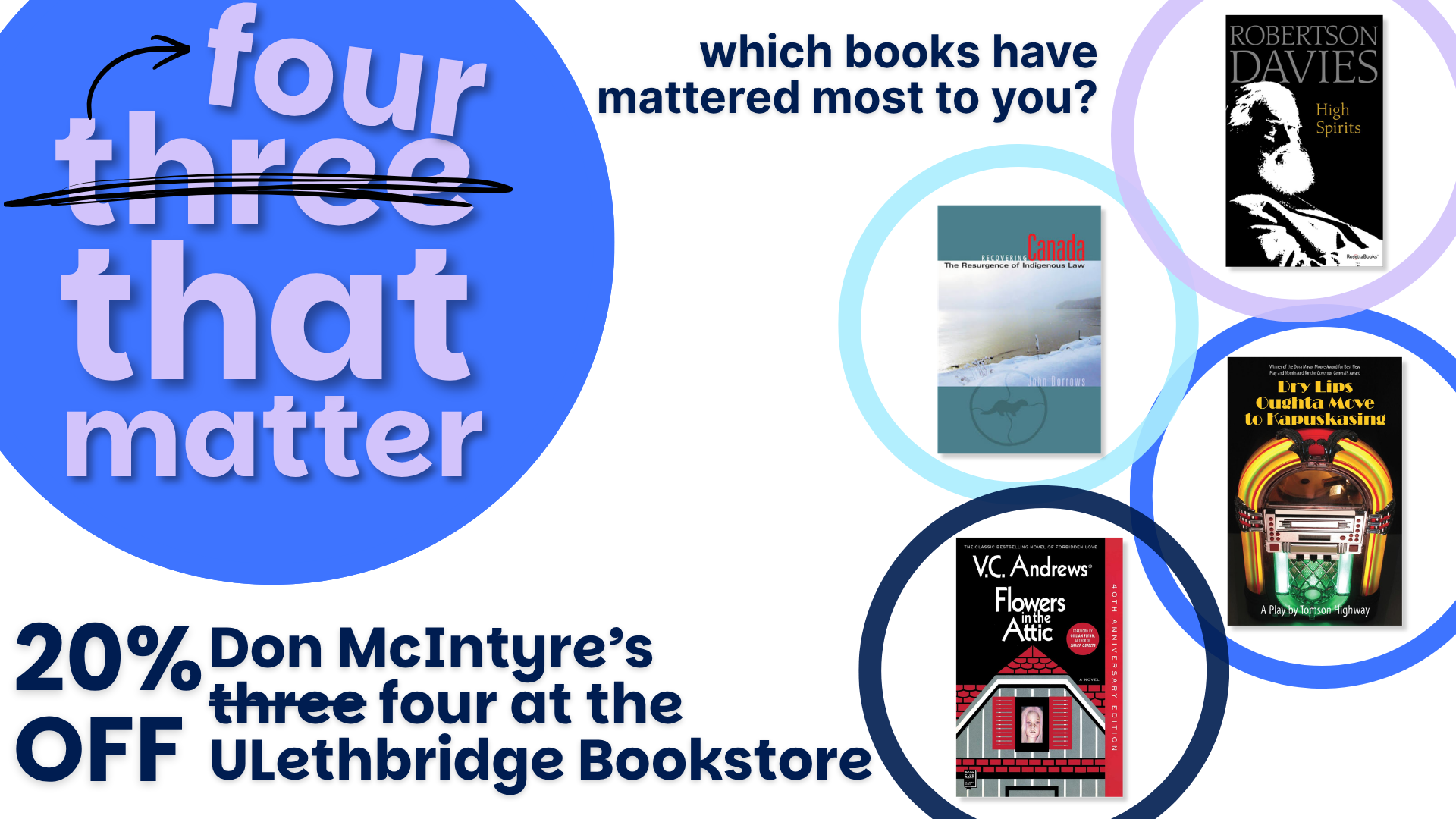
Book one: High Spirits by Robertson Davies
Why it matters
For 18 years, Robertson Davies shared a ghost story with the Gaudy Night (the annual Christmas party) guests at the University of Toronto Massey College. He shares his insecurities with the audience in a fun, thought-provoking way. I spend as much time looking references up as I do reading the text. Think of Nightmare Before Christmas for literary snobs. I met Dr. Davies at the PEN Festival (celebrating 100 years of writer advocacy this year; 2026) as a young volunteer backstage. We talked about writing, professoring, our grandfathers and their respective regalia. He, above all others, planted the seed that I could be a professor — the secret is a waistcoat and a pocket watch. This man and this book taught me that literature can be lofty and fun and that we must strive to be better while embracing our insecurities.
Book two: Recovering Canada by John Borrows
Why it matters
Dr. Borrows is one of the greatest thinkers regarding the intersection between Canadian and Indigenous systems of law and governance. In his first solo book, he posits that Indigenous law has continuing relevance for both Aboriginal Peoples and the Canadian state. He argues for the integration of Indigenous laws with Canadian law to produce a reconciled society where two worldviews coexist to create a better Canadian space. Borrows was the first time I saw an Anishinaabe as a true legal academic. I continue to use his work as a reflection of my world and academic perspectives. My writing and teaching expand his storytelling gifts into the realm of reconciling business and governance in Canada and around the world.
Book three: Dry Lips Oughta Move to Kapuskasing by Tomson Highway
Why it matters
A companion piece to Highway's earlier play, The Rez Sisters which focused on seven women from the fictional Wasaychigan Hill reserve, Dry Lips, is about the dreams, aspirations and folly of seven men from the Rez. Written in a mix of English, Cree and Ojibway, it tells a story of aspiration, magic realism, life and heartbreak on the Northern Ontario Reserve. Addressing issues like phobias, misogyny, racism and EDI (before EDI was a thing). It taught me that my stories were legitimate and that Indigenous people could be literary stars. Like the Nanabush/Trickster in the play, he/she taught me that the system can change with my story.
Book four: Flowers in the Attic by V.C. Andrews
Why it matters
The first book in the Dollanganger series, narrated by the fictional Cathy Dollanganger (Catherine Doll), it tells the story of how she and three siblings are locked in an old estate house and raised under the tyrannical control of their mother and grandmother. This book is important because of the lesson that came not from the book but from my mother. In 1979, I was 14 years old and well on the road to being an academic snob. My mother, who had a grade three education, was very proud of this big, real chapter book that she was reading and engaged with. I took the book to mock as beneath a “real reader." As I read line after line, page after page, trying to find its inferiority to The Castle of Otranto by Walpole, I became lost in the chapters. Eventually my mom and I fought for each new book in the series. It brought us together — and I like to think, it saved me from superciliousness, pomposity and pretentiousness. In short, it ensured I would not fall victim to sesquipedalian speech.
Closing thoughts
University of Lethbridge is a liberal education university. It dates to ancient times. "Liber" means free. Freeing your mind to explore diverse subjects, building on critical thinking, communication skills and good citizenship rather than narrow job training. It teaches us how to question, analyze and solve problems independently and prepares individuals to engage thoughtfully in our society and our democracy. Books have taken me across time and space. They have allowed me the freedom to explore worlds beyond my means and thereby expand my worldview and understandings.